





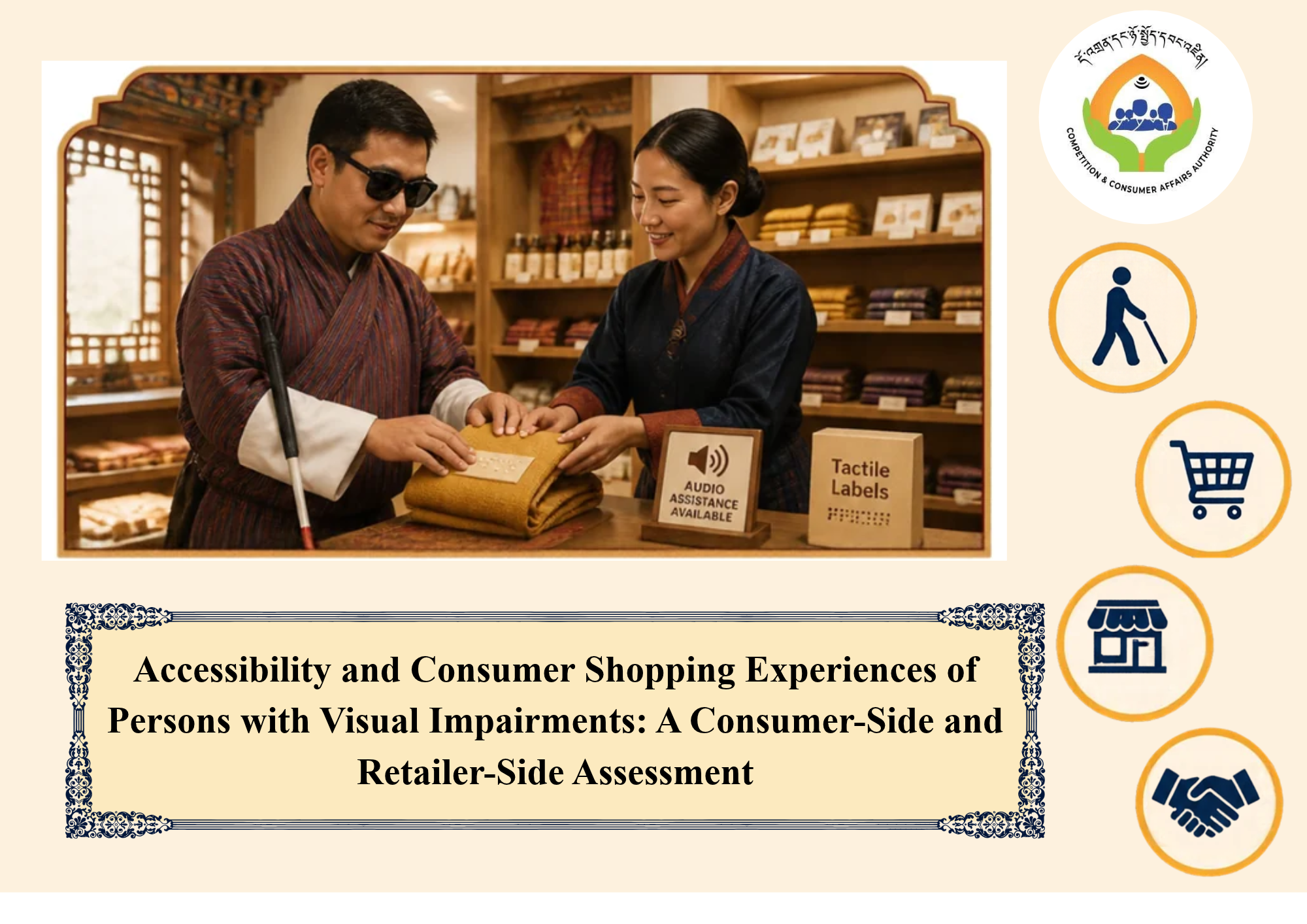
Shopping is an everyday activity. But how accessible is it when you cannot see?
Choosing a product, checking its price or expiry date, navigating a crowded shop and making a payment are things most consumers do without a second thought. For people with visual impairments, however, these ordinary tasks can mean depending on others for assistance.
For Karma Wangchuk, Assistant Program Officer at the CCAA, these are not just research questions but everyday realities. Visually impaired himself, Karma brings both personal experience and professional insight to a study he recently led on the shopping experiences of visually impaired consumers in Thimphu. A graduate in Sustainable Development from the College of Natural Resources, he has spent the past year contributing to CCAA’s research, consumer advocacy and public awareness initiatives. This is his first study as lead researcher.
Based on a survey of 30 visually impaired consumers and 15 retailers conducted during October–November 2026, the study reveals significant barriers to independent shopping.
Some key findings:
- 79% find independent shopping in Thimphu difficult, and only 23% shop fully independently.
- Navigating crowded shops (96%) and locating products (93%) are among the biggest challenges.
- 88% cannot independently read expiry dates, while 76% purchased something in the past year without checking its expiry date.
- 71% experienced consumer problems related to inaccessible information or inadequate assistance. Yet 59% did not know where to lodge a complaint, and 86% were unfamiliar with CCAA.
- Although retailers expressed willingness to help, none had received disability-related training or a complaint from a visually impaired customer. The absence of complaints, however, should not be mistaken for the absence of problems.
The study recommends practical measures, including accessible complaint channels, simple guidelines and voluntary staff training for retailers, and progressively improving the accessibility of banking applications and banknotes.
Its message is simple: making shopping more accessible does not always require major investments. Sometimes, it begins with speaking directly to the customer, offering assistance without making assumptions, and asking before helping.
A more accessible marketplace is a fairer marketplace for everyone.
Read the full study here: https://ccaa.gov.bt/wp-content/uploads/2026/11/Final-Report-Accessibility-and-Consumer-Shopping-Experiences-of-Persons-with-Visual-Impairments.pdf
